



Share
If you live outside the city limits in Texas, the internet struggle is real. Storms knock out your connection, calls freeze and shows buffer at the worst moment. Fiber and satellite are the two most common rural options, and knowing how they compare can help you choose the right one for your home.
What Is Fiber Internet?
Fiber internet sends data through glass cables using pulses of light. That signal travels quickly with very little interference, so fiber delivers a consistent connection. Many fiber providers also offer symmetrical speeds, so your upload speed matches your download speed, which helps with video calls and large file uploads.
Even as broadband expands nationwide, recent data shows the rural-urban gap in high-speed access has widened in dozens of states, which is part of why a fiber build matters so much locally.
What Is Satellite Internet?
Satellite internet connects your home to an orbiting satellite rather than to underground cables. It has long been popular in rural areas since it does not depend on nearby infrastructure. However, long-distance signals often mean higher latency, slower video calls and gaming, and extra buffering when streaming.
Newer satellite technology has narrowed the latency gap, but latency can still climb above 100 milliseconds in remote areas, well above typical fiber latency.

How Fiber and Satellite Compare
Here’s a quick look at how fiber vs satellite rural service stacks up based on key features.
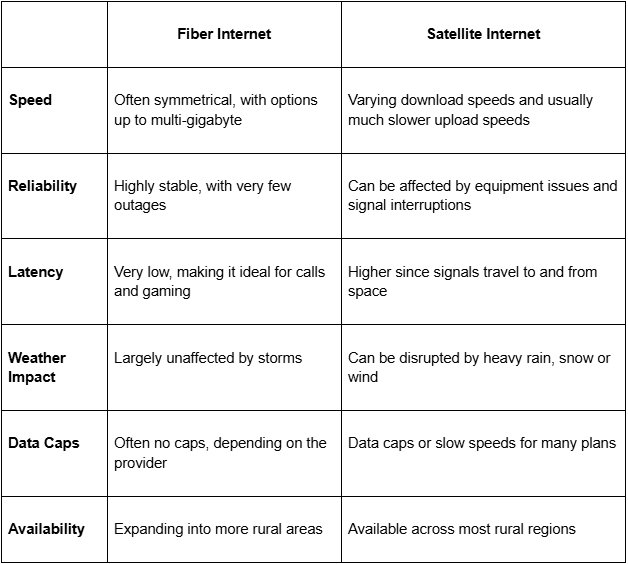
Finding a Fiber Provider Built for Rural Areas
Fiber has long felt out of reach in many rural areas, since large providers have focused on urban and suburban buildouts. That gap is starting to close. Highline is a rural-focused fiber provider that builds and operates its own fiber networks across underserved communities in several states, including Texas.
With Highline, rural households get symmetrical upload and download speeds, with plans reaching gigabit and multi-gigabit levels. There are no annual contracts, no data caps and no throttled speeds, plus whole-home mesh wifi to provide fast internet for all connected devices. The service also includes advanced network security, an optional voice service, and an app for managing your network and parental controls.

Frequently Asked Questions
Here are a few questions rural homeowners ask when comparing fiber and satellite internet.
Which is better for working from home in rural areas, fiber or satellite?
For most remote workers, fiber is the better choice. Its low latency and symmetrical speeds keep video calls, uploads and cloud tools running smoothly. Satellite can handle basic browsing and email, but higher latency may cause delays during meetings or large uploads.
What are the main differences between fiber and satellite internet?
The biggest differences come down to how each connection travels. Fiber uses cables and light signals to deliver faster speeds and lower latency. Satellite communications rely on signals traveling to and from space, which can introduce delays and make them more sensitive to weather.
How does the weather affect satellite internet compared to fiber?
Heavy rain, snow and high winds can interfere with the connection between your satellite dish and the orbiting satellite, sometimes causing slowdowns or outages. Fiber runs through underground or aerial cables, so it remains far more stable during storms, which matters in Texas’ weather swings.
Choosing What Works Best for Your Home
If storms knock out your connection or your shows buffer at the worst moment, it might be time for a change. Satellite remains widely available, but fiber’s speed, reliability and steady performance in bad weather make it the stronger pick for the best rural internet provider for your home.
______________________________________________________________________________________________________________________________________
Cover photo courtesy of WebFX
This post is a sponsored collaboration with WebFX